
Pool Filter Cleaning for Leander Area Pools
Pool filter cleaning in Leander keeps your water clear and protects your pump. We deep clean cartridge, sand, and DE filters, strip out the calcium and oils a hose can’t reach, restore proper flow, and tell you honestly when a filter is past saving.
Request A Free Quote
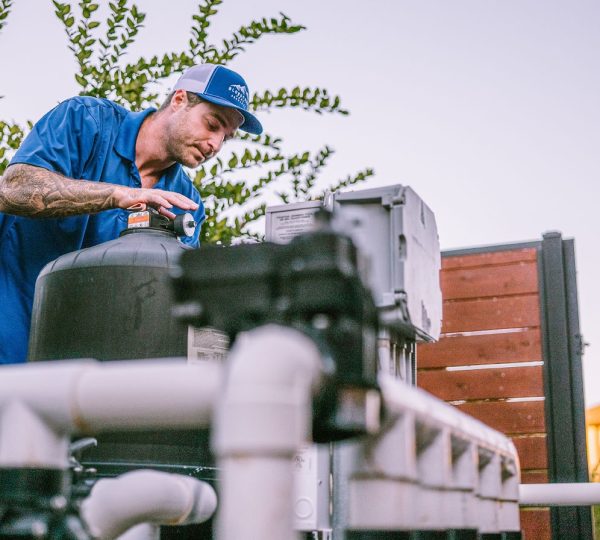
The part of your pool that quietly does the work
Nobody thinks about the filter until the water goes cloudy or the pressure gauge climbs. But a filter that’s loaded up is the reason a lot of pools stop looking right, and it’s an easy thing to stay ahead of. If your water isn’t clearing the way it should, request a free quote and we’ll take a look.
We clean cartridge, sand, and DE filters across Leander and the northwest Austin corridor. Fully insured, and we’ll tell you honestly whether your filter needs a cleaning or has reached the end of its life.
How often a filter needs cleaning
The honest answer is: more often here than the manual says. Central Texas is hard on filters for two reasons that stack on top of each other.
Spring pollen is the first. Cedar and oak coat everything for weeks, and all of it ends up in the filter. A filter that was fine in February can be struggling by April.
Hard water is the second. Our limestone geology means calcium in the water, and calcium builds up inside cartridges and DE grids, stiffening the media so it can’t flow the way it should. That buildup doesn’t rinse off with a hose, which is why filters that “look clean” sometimes still perform badly.
As a rule, most pools here want the filter cleaned every three to four months, and more often during pollen season or after a green pool recovery, when the filter has been catching dead algae.

How we clean each filter type
Cartridge filters. Pulled, disassembled, and deep cleaned between the pleats, where debris and oils hide. A rinse from a garden hose does not do this, which is why many home-cleaned cartridges still run at high pressure.
DE filters. Backwashed, opened, and the grids cleaned properly, then recharged with the correct amount of DE. Too little and you lose filtration; too much and you choke the flow.
Sand filters. Backwashed and inspected. Sand does wear out, and channeled or clumped sand filters poorly no matter how much you backwash, so we check whether it’s actually the sand.
Where calcium has built up, a chemical soak is what actually restores flow, and that’s a job worth doing right rather than skipping.
Signs your filter needs attention
Your pool usually tells you before the gauge does.
Rising pressure. The classic sign. When your filter pressure runs well above where it sat when clean, flow is being restricted.
Cloudy water that won’t clear. If chemistry is in range and the water still looks dull, the filter probably isn’t catching what it should.
Weak returns. If the water coming back into the pool has lost its push, something is restricting flow, and it’s often the filter.
The pump working harder. A clogged filter makes the pump strain, and a straining pump wears out early. This is how a cheap filter cleaning turns into an expensive pump repair.
Know your clean pressure
Here’s the single most useful thing a pool owner can know, and almost nobody does: the pressure your filter runs at when it’s freshly clean.
That number is your baseline, and it’s different for every pool. Once you know it, the gauge tells you when it needs attention, because it climbs above it as the filter loads up. Without a baseline, the gauge is just a number that means nothing, which is why most people ignore it entirely until the water turns.
When we clean a filter, we note where the pressure sits afterward, and we tell you. It costs nothing, and it turns your pressure gauge from decoration into an actual instrument. If you’re on a maintenance plan, we’re tracking it for you and cleaning the filter when it actually needs it rather than on an arbitrary calendar.
The other half is knowing what’s normal for your pool through the year. Filter pressure climbs faster in spring, when pollen is heavy, and slower in quieter months. A filter loading up fast in October, when nothing’s falling in, is telling you something different than one loading up in April.

Cleaning or replacing
Filters don’t last forever. Cartridges have a life measured in years, and eventually the pleats break down, and no amount of cleaning brings back the performance. Sand channels. DE grids tear.
When a filter has reached that point, cleaning it is throwing money away, and we’d rather tell you that than take payment for a service that won’t fix your water. If it’s genuinely time for a replacement, our pool filter repair service handles it.
Where we clean filters
Across the corridor, from Leander to Cedar Park.
We clean filters in Georgetown and Round Rock too, along with Liberty Hill and the Lake Travis communities.
See our areas served page for the full list.

Pool filter cleaning FAQs
How often should a pool filter be cleaned?
In Central Texas, most pools do best with a filter cleaning every three to four months, and more often through spring pollen season. Our hard water and heavy pollen load a filter far faster than the manufacturer’s manual assumes, so the interval printed in that manual is usually optimistic here. We’ll look at how quickly yours actually loads up and give you a realistic schedule for your specific pool rather than a generic number. Wondering about timing? See how often to clean your filter and why the pressure gauge decides.
Can I just hose off my cartridge filter myself?
You can rinse it, and that does help a little, but it doesn’t do the real job. Debris and body oils pack down between the pleats where a hose stream skips right over, and calcium from our hard water builds up inside the media where rinsing simply can’t reach. That’s exactly why home-rinsed cartridges still tend to run at high pressure. A proper deep clean pulls the pleats apart and soaks out what a hose leaves behind.
What does high filter pressure mean?
It means flow through the filter is restricted, and that’s almost always because the filter has loaded up with debris and calcium. When the gauge sits well above where it read with a clean filter, usually eight to ten psi higher, the filter needs attention. Ignore it, and the pump has to strain against that restriction every hour it runs, which overheats the motor and quietly shortens the pump’s life, turning a cleaning into a replacement.
Do you clean sand and DE filters, or only cartridge?
All three, and each gets handled the way it needs. Cartridge filters get pulled and deep cleaned pleat by pleat. DE filters get fully backwashed, with the grids cleaned and the diatomaceous earth recharged to the right amount. Sand filters get backwashed, and the sand inspected, since old sand channels and stops straining properly. Each type fails in its own way, so a single one-size approach doesn’t actually clean them.
How do I know if my filter needs replacing instead of cleaning?
It comes down to age and performance together. Cartridge media breaks down after a few years of use, sand develops channels that let water pass unfiltered, and DE grids tear and stop holding powder. If a filter we’ve just properly cleaned still can’t hold its pressure or clear the water, another cleaning won’t fix it; it’s worn out. We’ll tell you plainly when a filter has reached that point rather than selling you a cleaning that won’t last.
Will cleaning the filter fix my cloudy water?
Often, yes, provided the chemistry is otherwise in range. Cloudy water that won’t clear no matter what chemicals you add usually means the filter isn’t catching the fine particles it should, and a deep clean restores that. But if there’s a circulation problem sitting behind it, a weak pump or a bypassing valve, we’ll find that too, because even a spotless filter can’t clear water that isn’t actually moving through it at the right rate.
How much does pool filter cleaning cost?
Filter cleaning is priced by filter type and how loaded it is, since the work varies a lot. A routine cartridge clean is quick, while a DE filter needing a full teardown, grid cleaning, and a calcium soak is a much bigger job. A neglected filter that’s caked solid takes longer than one cleaned on schedule. We’ll see what you’ve got, quote the actual job, and tell you if it’s cheaper to replace than keep cleaning.
Cloudy water or rising pressure usually starts here. Tell us about your pool, and we will take a look.