
Pool Equipment Repair for Leander Area Pools
Pool equipment repair in Leander covers pumps, filters, heaters, salt systems, and valves. We treat the equipment pad as one connected system, because the part that’s making noise or failing is often not the part that’s actually broken, and we diagnose before we replace.
Request A Free Quote
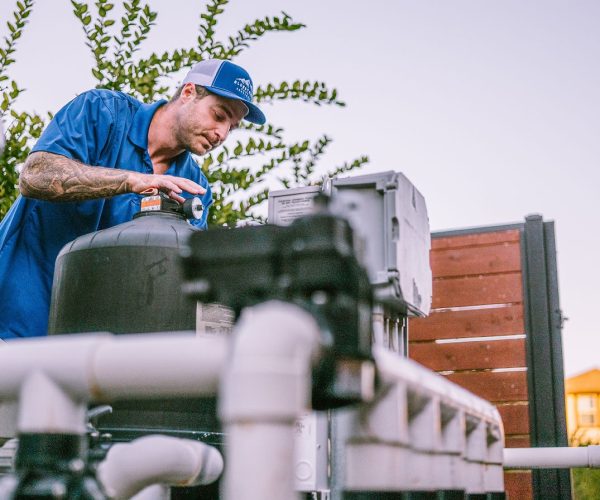
The equipment pad, as a system
Your pump, filter, heater, salt cell, and valves are not separate machines that happen to sit next to each other. They are one system, and a fault in any of them shows up as a symptom somewhere else. That is why diagnosing pool equipment by symptom alone goes wrong so often. Request a free quote, and we will look at the whole pad.
We repair pool equipment across Leander and the northwest Austin corridor. Fully insured, and we find the actual fault rather than replacing the loudest part.
Why symptoms mislead
Almost every equipment call starts with a symptom that points at the wrong component.
Cloudy water looks like a filter problem. It is often a pump not moving enough water for the filter to do anything, or a valve quietly bypassing.
A loud pump looks like a failing pump. It is often a pump starving because a basket is packed or a filter is loaded, and it is telling you about a restriction rather than about itself.
A heater that will not fire looks like a heater problem. It is usually a flow problem, and the heater is refusing to run because its safety switch is doing exactly what it should.
A salt cell reporting low output looks like a dead cell. It is usually scale, and often a clean rather than a replacement.
The through-line is that the component making the noise is frequently the victim rather than the culprit. Replace it and the real fault is still there, waiting, and now you have paid for a part you did not need. This is how people end up buying two pumps in three years and concluding that pool equipment is junk.

What we work on
Pumps. Motors, seals, capacitors, impellers. See pool pump repair.
Filters. Cartridges, grids, sand, housings, and valves. See pool filter repair.
Heaters. Ignition, sensors, flow faults, and scaled exchangers. See pool heater repair.
Salt systems. Cells, controllers, and output problems.
Valves and plumbing. Multiport valves that bypass internally, failed unions, and the leaks that quietly cost you flow.
Pool lights. Fixtures and transformers.

What Central Texas does to an equipment pad
Equipment here has a harder life than the manufacturer assumed, and it fails in predictable ways.
Sun destroys plastic. An unshaded equipment pad bakes for most of the year. Housings get brittle, unions crack, and seals dry out. Shade over the pad is one of the cheapest things you can do for equipment life, and almost nobody does it.
Hard water scales everything. Heat exchangers, salt cells, and filter media all accumulate calcium, and everything works harder as a result.
The season never really stops. Equipment that would rest for months elsewhere runs most of the year here, and the hours add up faster than anyone expects. A pump in Central Texas can accumulate several seasons’ worth of northern running time in a single year.
See how long pool equipment lasts in Texas heat to weigh repair against replacement.
Catching it early
Nearly every expensive equipment failure we see had a cheap early stage that nobody was watching for. A seal weeping slightly. A pressure gauge creeping up. A pump that got a little louder.
That is the honest argument for a maintenance plan, and it is not really about the cleaning. It is that someone is looking at the pad every week, and the difference between catching a failing pump in spring and discovering it in July is substantial.

What we will tell you honestly
Equipment repair is the corner of pool service where it is easiest to overcharge people, because most homeowners cannot verify what they are told. A contractor can point at a pump, say it is finished, and be believed.
So here is how we handle it. If the fault is cheap, we tell you it is cheap, even when a bigger job was available. If a part can be cleaned rather than replaced, which is very often the case with salt cells, we clean it. If the equipment is genuinely at the end and a repair would be throwing money at it, we say that too, even though it is the more expensive answer and you may not want to hear it.
What you will always get is the reasoning before the work, not after. If we cannot explain to you why a part needs replacing, in terms that make sense, then we have not diagnosed it properly, and you should not be paying for it.
Where we repair equipment
Across the corridor, from Leander to Cedar Park.
We repair equipment in Round Rock and Georgetown too, plus the Lake Travis communities. See our areas served page.

Pool equipment repair FAQs
My water is cloudy, but the filter seems fine. What is wrong?
Often the pump isn’t moving enough water for the filter actually to do its job, or a multiport valve is bypassing internally and quietly routing water around the filter instead of through it. A perfectly good filter can’t clean water that isn’t properly reaching it. We check the flow rate and the valves, not just the filter itself, because on the pad a clean filter paired with cloudy water usually points upstream to how the water is moving.
Why does pool equipment fail so fast in Texas?
Three things stack up here. The sun beats down on an unshaded equipment pad, destroys plastic housings, and dries out seals and O-rings well before their time. Our hard water scales up heat exchangers, salt cells, and filter internals from the inside. And the long swim season means the equipment simply runs far more hours a year than the same gear would in a cooler climate. Together they age a pad fast.
Can you repair equipment if I am not a regular customer?
Yes, and there’s no catch to it. You don’t have to be on a maintenance plan for us to come out and fix your equipment, and plenty of our repairs are for people we’ve never serviced before. We’ll diagnose the pad, fix what’s failed, and explain what we found, and whether you ever book us for anything else is completely your call. Some become regulars afterward, many just wanted the one repair, and both are genuinely fine.
Should I shade my equipment pad?
If you can, yes, it’s one of the highest-value, lowest-cost things a pool owner can do. Direct Texas sun genuinely shortens the life of everything on the pad, baking the plastic, cracking the seals, and cooking the electronics. It doesn’t need to be elaborate; a simple structure or even a well-placed bit of shade that keeps the afternoon sun off the pad pays for itself in years added to your pump and heater.
How do I know which piece of equipment is actually broken?
Honestly, you often can’t tell from the symptoms alone, and anyone claiming otherwise over the phone is guessing. The component making the noise or throwing the error is frequently the victim of a fault somewhere else on the pad, a pump straining because of a clogged filter, say. That’s exactly why we look at the whole system and trace a symptom back to its real source rather than just replacing the part that’s complaining the loudest.
Is it worth repairing older pool equipment?
It depends on the specific part and the age of the unit. Seals, capacitors, sensors, O-rings, and valves are almost always worth repairing; they’re cheap, and they restore the whole unit to working order. A failed motor or a corroded heat exchanger on genuinely old equipment is where replacing it often makes better financial sense than pouring money into it. We’ll give you both numbers and the honest tradeoff rather than steering you toward the bigger ticket.
How quickly can you look at failed equipment?
We’ll get to you as fast as our schedule honestly allows, and we’ll give you a real timeframe rather than a promise we can’t keep. Equipment failures aren’t all equally urgent, though, so tell us what’s happening: a pump that’s dead in peak summer heat, where the water can turn green fast, gets treated differently than a heater that quits in October. We prioritize the failures that will otherwise drag the whole pool down with them.
Something on the pad not working right? Tell us what it is doing, and we will find the actual fault.